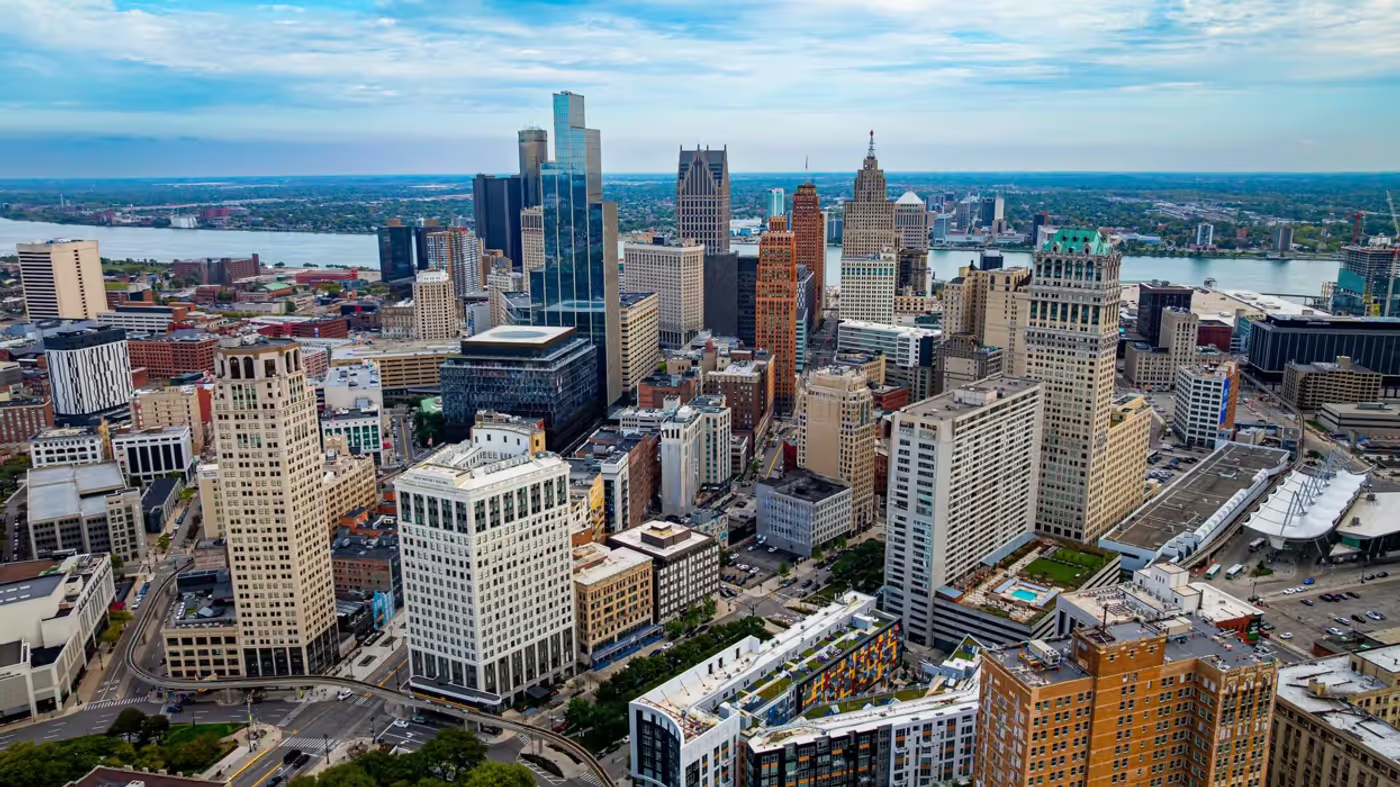
A car crash in Detroit is a Michigan no-fault claim first and a Detroit claim second. The no-fault part is the same everywhere in the state: an insurer determined under Michigan’s no-fault priority rules may pay covered medical expenses and wage-loss benefits regardless of fault. A claim for pain and suffering against the at-fault driver generally requires an injury meeting Michigan’s statutory threshold. The Detroit part is what this page is about. The driver who hit you may be uninsured or carry only the minimum liability coverage. The vehicle is more likely to belong to the City: a DDOT bus, a police car, a Public Works truck. The crash is more likely to involve a pedestrian; Detroit accounted for 420 of Wayne County’s 637 pedestrian-involved crashes in 2024. The road may be the City’s, the County’s, or the State’s, and the notice goes to a different office for each. And the case will be in the Third Circuit or the 36th District, which run differently from the suburban courts.
ATLAW is a personal injury firm with an office at 3 Parklane Boulevard in Dearborn, a short drive from downtown Detroit. In 13 years the firm has handled more than 10,000 cases and recovered more than $100 million for clients, including clients with Detroit crash claims involving insurers, uninsured drivers, and government agencies. Our Michigan car accident lawyer page covers the law in full and our Detroit page covers every kind of injury claim in the city; this page covers what is different about a Detroit car crash claim and what to do about it. The first conversation is free: (313) 406-7606.
Detroit car crashes by the numbers
| Measure | Figure | Source |
|---|---|---|
| Detroit crashes / people injured / killed, 2024 | 24,321 / 8,872 / 104 | MSP Michigan Traffic Crash Facts, city profile |
| Wayne County crashes, 2024 | 50,355 | MSP, Michigan Traffic Crash Facts 2024 |
| Wayne County injured / seriously injured / killed | 16,458 / 926 / 177 | MSP 2024 |
| Pedestrian-involved crashes in Detroit, 2024 | 420 (two-thirds of Wayne County’s 637; the county had 40 pedestrian deaths) | MSP, Pedestrian Crash Report 2020–2024 |
| Wayne County alcohol-involved crashes, 2024 | 1,331 | MSP 2024 |
| Wayne County crashes involving trucks and buses, 2024 | 3,916 | MSP 2024 |
| Highest-crash Detroit intersections, 2024 | Joy Road at M-39 (78 crashes, 27 injuries); Seven Mile Road at I-75 (69 crashes, 36 injuries) | MSP Traffic Crash Reporting Unit data, as analyzed by Michigan Auto Law |
| Deaths per 1,000 crashes, Wayne County, 2024 | 3.5 (Oakland County: 1.9) | Calculated from MSP 2024 |
| Detroit drivers uninsured before the 2019 reform | About 60 percent, per state regulators’ estimates | Michigan DIFS |
Wayne County accounted for approximately 23% of Michigan’s crash injuries and 17% of its crashes in 2024. Truck and bus crashes are covered on our Detroit truck accident page; motorcycle crashes on our Detroit motorcycle accident page.
Where Detroit car crashes happen
The freeways. I-94 (the Edsel Ford) across the city from Dearborn to the Grosse Pointes; I-75 (the Fisher and the Chrysler) from Downriver through Southwest Detroit, downtown, and the North End to Eight Mile; I-96 (the Jeffries) from Redford to the I-75 interchange; M-10 (the Lodge) from the riverfront to Southfield; M-39 (the Southfield Freeway) along the west side; and M-8 (the Davison). The interchanges, I-94/I-75, I-75/I-96, I-94/M-10, I-96/M-39, I-75/M-8, carry the merging and lane-change crashes. The older stretches with short ramps and left-hand exits, the Lodge and the Davison in particular, carry the rear-end and sideswipe crashes. The freight to the Ambassador Bridge and the Gordie Howe International Bridge, which opened in July 2026, puts heavy trucks on all of them.
The arterials. Gratiot, Woodward, Grand River, Michigan Avenue, Fort Street, Jefferson, Van Dyke, Livernois, Warren, Davison, McNichols, Seven Mile, Eight Mile, and Telegraph. They are wide, multi-lane, posted at 35 to 45 miles an hour and driven faster, signalized at long intervals, and crossed on foot by residents of neighborhoods with limited transit. The result is the city’s left-turn, red-light, and pedestrian crashes, and high-crash intersections such as Southfield Freeway at Warren and Livernois at Davison, both wide arterial crossings on the west side. Many of these roads are state trunklines (Woodward is M-1, Gratiot M-3, Grand River M-5, Fort M-85, Eight Mile M-102, Michigan Avenue US-12, Telegraph US-24), which matters when the road itself contributed to the crash; see below.
The neighborhoods. Residential streets with missing or faded stop signs, dark blocks where streetlights are out, and the side-street crashes that follow. A missing sign or a dark intersection can make the City a defendant alongside the other driver, with a 120-day notice clock.
Downtown, Midtown, and the venues. Ford Field, Comerica Park, Little Caesars Arena, the casinos, and the Greektown and Corktown bar districts produce the late-night crashes: drunk drivers, rideshare vehicles, and pedestrians leaving events. A bar that over-served a visibly intoxicated driver can be liable under Michigan’s dram shop act, MCL 436.1801, with a 120-day notice requirement. See our Detroit rideshare accident page and drunk driving accident page.
Who pays after a Detroit car crash
A Detroit car crash may involve two separate claims: a no-fault benefits claim and a claim against a responsible driver.
Your no-fault (PIP) claim, against your own insurer. Under MCL 500.3107, an applicable no-fault insurer may pay covered medical expenses up to the available PIP medical limit, if medical coverage applies. Coverage depends on the injured person’s insurance priority, eligibility, available medical coverage, and statutory exclusions. Benefits also include 85 percent of eligible lost income for up to three years (capped at $7,455 per 30-day period for accidents occurring from October 1, 2026, through September 30, 2027), replacement services at $20 a day, and attendant care, regardless of who caused the crash. If you have no policy, the order is your spouse’s or a resident relative’s policy (MCL 500.3114); if none exists, the Michigan Assigned Claims Plan (MCL 500.3172), which assigns an insurer and caps medical benefits at $250,000. The insurer must receive written notice within one year of the crash (MCL 500.3145(1)) and must pay each bill within 30 days of reasonable proof or owe 12 percent interest (MCL 500.3142). Our no-fault insurance claim page covers the application, the benefits, and the denials.
Your claim against the at-fault driver. For pain and suffering, you generally must establish death, serious impairment of body function, or permanent serious disfigurement under MCL 500.3135. Certain economic losses beyond available no-fault benefits may be recoverable separately under MCL 500.3135(3)(c), without the same injury threshold. “Serious impairment” means an objectively manifested impairment of an important body function that affects your general ability to lead your normal life, as the Michigan Supreme Court defined it in McCormick v Carrier (2010) and the Legislature codified in 2019; it does not require permanence. The deadline is three years (MCL 600.5805(2)). Noneconomic damages are reduced by your share of fault and generally barred if you are found more than 50 percent at fault. Economic damages require a separate comparative-fault analysis. For vehicle damage, the mini tort under 3135(3)(e) recovers up to $3,000 from the at-fault driver for damage your own collision coverage does not pay; it is filed in the 36th District Court if the driver’s insurer will not pay it.
Where the two claims meet. Under Michigan’s reformed no-fault law, available PIP medical options include unlimited coverage, $500,000, $250,000, $250,000 with qualifying exclusions, $50,000 for eligible Medicaid households, and medical PIP opt-out for qualifying Medicare households. A Detroit driver who chose $50,000 or $250,000 to afford the policy can exhaust it in a single hospitalization. Qualifying medical expenses above an applicable PIP medical limit may be recoverable from a legally responsible at-fault driver as excess economic damages under MCL 500.3135(3)(c).
What is different about a Detroit car accident claim
The other driver is more likely to be uninsured. Michigan’s 2019 no-fault reform was driven largely by Detroit’s premiums and its uninsured rate; before the reform, state regulators estimated that about 60 percent of Detroit drivers were driving without insurance. Michigan’s 2019 no-fault reform introduced lower-cost coverage options and was followed by a statewide decrease in uninsured driving. In Detroit, identifying available liability, PIP, and UM/UIM coverage remains especially important. For your claim this means three things. An injured person without an applicable PIP insurer may need to seek benefits through the Michigan Assigned Claims Plan. Michigan permits drivers to select bodily-injury liability limits as low as $50,000 per person and $100,000 per accident, rather than the default $250,000/$500,000 limits. And your own uninsured and underinsured motorist coverage is more often the real recovery; we read every policy in the household before we value a Detroit claim. See our uninsured motorist page.
Hit-and-run crashes are more common. When the other driver leaves the scene, identifying available coverage can be difficult. An eligible injured person may still pursue applicable no-fault benefits, subject to Michigan’s priority rules and exclusions. Your injury claim depends on your uninsured motorist coverage, and UM policies carry their own conditions: some policies require prompt police reporting, written notice within a specified period, or evidence of physical contact with the unidentified vehicle. Report the crash to Detroit Police the same day, get the report number, and notify your insurer in writing that week. Whether your policy requires contact, and what its notice period is, depends on the policy, not on a statute.
The other vehicle may belong to the City. DDOT buses (and SMART buses on the suburban routes into downtown), Detroit Police, Fire, and EMS vehicles, Department of Public Works trucks, and Detroit Water and Sewerage vehicles. A crash involving a government-owned vehicle may fall under the Governmental Tort Liability Act’s motor vehicle exception, MCL 691.1405, when the statutory requirements are met. Available DDOT video, police camera footage, dispatch records, and Project Green Light recordings should be identified and preservation requested promptly. Access procedures and retention periods vary by the record and the entity holding it. See our bus accident page.
The road itself may be the defendant, and the notice goes to a different office for each road. A crash caused by a qualifying defect in the traveled roadway may implicate the highway exception to governmental immunity. Missing signs, malfunctioning signals, lighting, and roadway design require separate legal analysis. On MDOT-maintained freeways and state trunklines, a qualifying highway-defect claim generally requires written notice within 120 days, filed in the Court of Claims under MCL 691.1404. Some Detroit roads remain under Wayne County jurisdiction. The highway exception covers the traveled portion of the roadbed, not the surrounding area, and the notice must state the exact location, the nature of the defect, the injury, and the known witnesses. Notice to the wrong agency is not notice. On Belle Isle, a state park since 2014, road and premises claims are against the Michigan Department of Natural Resources in the Court of Claims.
The other driver may be from Ontario or out of state. The Ambassador Bridge, the Detroit-Windsor Tunnel, and I-75 and I-94 bring Ontario, Ohio, and other out-of-state drivers through the city daily. A nonresident generally cannot recover Michigan PIP benefits unless they own a motor vehicle registered and insured in Michigan (MCL 500.3113(c)).
Rental cars and rideshare vehicles are common downtown and near the airport. Coverage after a rental-car crash depends on applicable Michigan law, the renter’s insurance, the rental company’s statutory obligations, and the available policy terms. Michigan law requires at least $1 million in liability coverage during a prearranged rideshare trip, with different minimum coverage requirements while the driver is logged on and waiting for a request (MCL 257.2123). See our Detroit rideshare page and passenger injury page.
The pedestrian cases. Four hundred twenty pedestrian-involved crashes in the city in 2024. A pedestrian struck by a car is covered by no-fault through their own or a household policy first, then the insurer of the vehicle’s owner, then its operator, then the Assigned Claims Plan (MCL 500.3115), and has the same threshold claim against the driver. Michigan’s comparative-fault rule applies to pedestrians, and fault may be disputed based on the crosswalk, signal phase, visibility, and other circumstances. See our pedestrian accident page and bicycle accident page.
The case will be in the Third Circuit or the 36th District. Injury suits over $25,000 are filed in the Third Judicial Circuit Court at the Coleman A. Young Municipal Center, 2 Woodward Avenue, which has its own case evaluation and facilitation practices. Claims up to $25,000, including mini tort claims, go to the 36th District Court at 421 Madison Street. Wrongful death matters may require estate proceedings in Wayne County Probate Court, while the wrongful-death lawsuit itself proceeds in the court with jurisdiction. Settlements involving minors require court approval under MCR 2.420. Where the defendant lives or does business elsewhere, venue may be available in another county (MCL 600.1629).
The police report may take longer. A crash with no report becomes a dispute about what happened. Michigan requires a police report for any crash with injury or at least $1,000 in damage (MCL 257.622). If no officer responds, contact Detroit Police promptly about the applicable process for making a crash report. If the report contains an error, contact the reporting police agency promptly to ask about its correction or supplemental-report procedure.
The hospitals. DMC Sinai-Grace on the west side, Harper University Hospital in Midtown, and Henry Ford St. John Hospital on the east side are additional regional treatment facilities. We obtain the complete record from each, including the Detroit EMS run sheet, which often contains the first account of how the crash happened and what the injured person said at the scene.
What to do after a Detroit car crash
- Stop, call 911 if anyone is hurt, and call police. If no officer responds, go to the precinct and file the report; do not let the crash go unreported.
- Photograph everything before the scene clears: the vehicles, the plates, the other driver’s license and insurance card, the signals and signs, the road surface, and any camera on a nearby business or Green Light location.
- Get the names and numbers of witnesses. In Detroit, witnesses leave quickly.
- Get medical care the same day and tell the provider it was a car crash. A gap between the crash and the first visit is the insurer’s first argument.
- Report to your own insurer and request the Application for No-Fault Benefits. File it within the first week, not the eleventh month.
- Read your declarations page for PIP level, UM/UIM, and collision coverage. In Detroit this is the step that decides what the claim is worth.
- Do not give a recorded statement to the other driver’s insurer, sign a medical authorization, or sign a release.
- Stay off social media about the crash and your activities.
Our full checklist covers the first day, week, month, and year, and our Michigan no-fault guide covers the application and the benefits in detail.
Deadlines for Detroit car accident claims
| What | When | Statute |
|---|---|---|
| Written notice of injury to your no-fault insurer | 1 year from the crash | MCL 500.3145(1) |
| Suit for unpaid no-fault benefits | Generally subject to the one-year-back rule under MCL 500.3145(2), with statutory tolling for qualifying claims submitted to an insurer under subsection (3). | MCL 500.3145(2) |
| Hit-and-run or UM claim notice | Per policy; often 24 hours to police and a short period to the insurer | Policy terms |
| Dram shop claim against a bar | Generally two years to sue; written notice within 120 days after establishing an attorney-client relationship to pursue the dram shop claim, subject to statutory exceptions | MCL 436.1801 |
| Road defect claim against the City of Detroit or Wayne County | Written notice within 120 days | MCL 691.1404 |
| Claim against MDOT, the State, or MDNR (Belle Isle) | Qualifying highway-defect claim: written notice within 120 days, filed in the Court of Claims; other qualifying personal-injury claims against the State may be governed by the six-month notice provision | MCL 691.1404, 600.6431 |
| Suit against the at-fault driver | 3 years from the crash | MCL 600.5805(2) |
| Mini tort for vehicle damage | 3 years | MCL 600.5805(2) |
| Wrongful death | 3 years from death, with the savings provision for estates | MCL 600.5805(2), 600.5852 |
Why Detroiters call ATLAW
- An office at 3 Parklane Boulevard in Dearborn, with free surface parking, and 13 years, more than 10,000 cases, and more than $100 million recovered for clients.
- Daily work in the Third Circuit and the 36th District, and with the Assigned Claims Plan, DDOT, the City’s law department, and the insurers that write Detroit policies.
- Every household policy read, and every UM/UIM and PIP option identified, before the claim is valued.
- Prompt attention to preservation of available DDOT, police, and Project Green Light video evidence.
- No fee unless we recover money for you. ATLAW advances case costs, so you pay nothing up front; the 33.3% attorney fee is calculated on the recovery after those costs are deducted, and if there is no recovery you owe no fee and no costs. The first conversation is free.
- Consultations are available in English, Arabic, French, Mandarin, Urdu, and Spanish. We welcome clients to our Dearborn office for a consultation. If you are unable to visit, home or hospital visits can be arranged as needed.