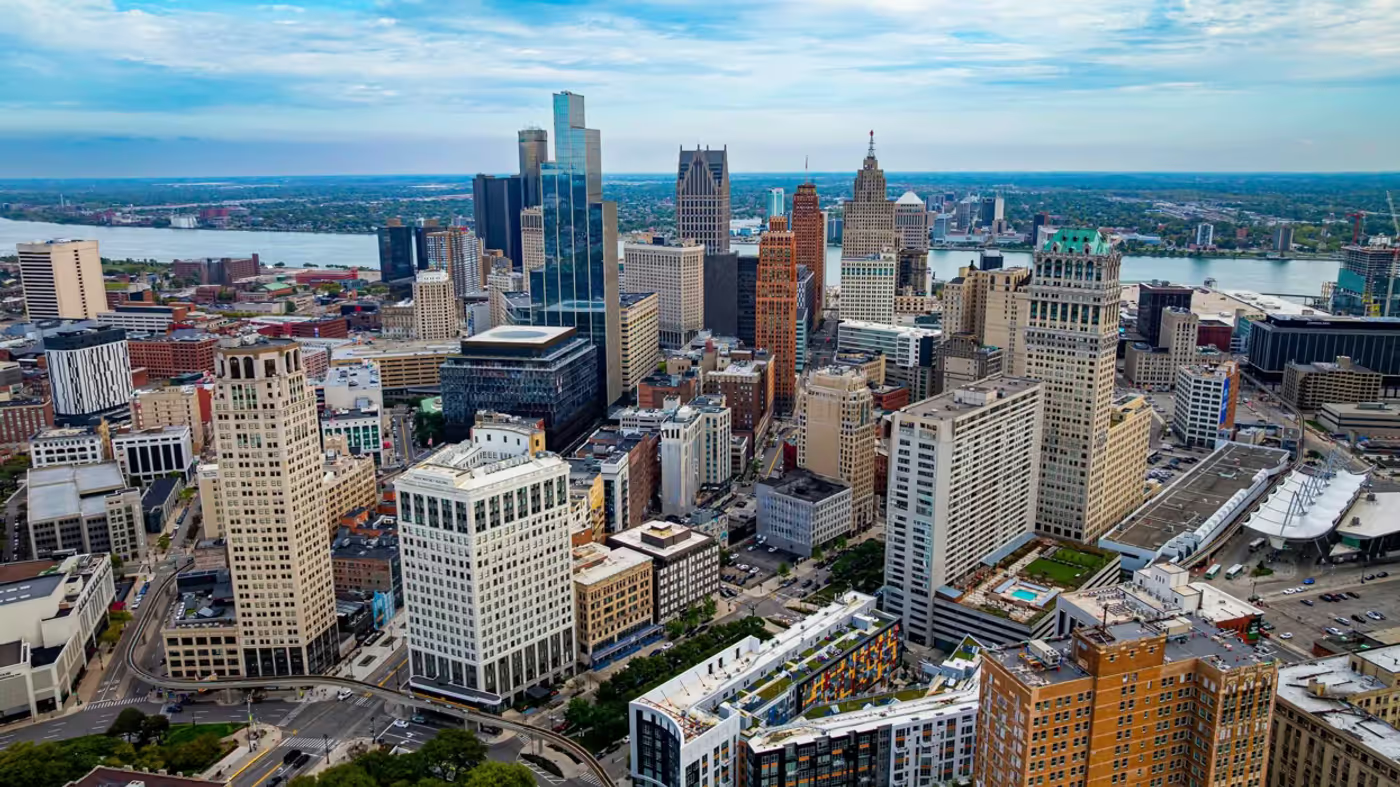
A motorcycle crash in Detroit is governed by a rule most riders learn only after they are hurt: under Michigan no-fault, a motorcycle is not a “motor vehicle.” That one definition decides who pays your medical bills, how much they pay, whether you have any no-fault claim at all, and how the insurer will argue the helmet question. Add Detroit’s roads, its share of uninsured drivers, and the City as a potential defendant, and a Detroit rider’s claim has more moving parts than a car occupant’s.
ATLAW is a personal injury firm with an office at 3 Parklane Boulevard in Dearborn, serving Detroit and communities throughout southeast Michigan. In 13 years the firm has handled more than 10,000 cases and recovered more than $100 million for clients. Our Michigan motorcycle accident lawyer page covers the no-fault rules for riders in full, our Detroit page covers every kind of injury claim in the city, and our Detroit car accident page covers crashes between cars; this page covers what is particular about a Detroit motorcycle crash. The first conversation is free: (313) 406-7606.
Motorcycle crashes by the numbers, 2024
| Measure | Figure | Source |
|---|---|---|
| Motorcycle crashes in Detroit / people injured / killed | 256 / 217 / 18 | MSP crash data, via SEMCOG |
| Motorcycles in Wayne County crashes / riders injured / killed | 509 / 367 / 24 | MSP, 2024 Wayne County profile |
| Michigan motorcycle crashes / riders injured / killed | 3,187 / 2,460 / 168 | MSP, 2024 Motorcycle Crash Facts |
| Share of Michigan rider deaths involving alcohol | 31 percent | MSP 2024 |
| Wayne County crashes / injured / killed, all vehicles | 50,355 / 16,458 / 177 | MSP 2024 |
| Deaths per 1,000 crashes, Wayne County | 3.5 (Oakland: 1.9) | Calculated from MSP 2024 |
| Michigan minimum liability limits for the at-fault driver | $50,000 per person / $100,000 per crash | MCL 500.3009(1) |
| Medical coverage required to ride without a helmet (age 21+) | $20,000 first-party medical | MCL 257.658 |
Statewide, about one rider in nineteen involved in a crash was killed in 2024, a rate many times that of car occupants, because there is nothing between the rider and the pavement or the other vehicle. Detroit’s wide, fast arterials and its freeway interchanges are where its motorcycle crashes concentrate.
Where Detroit motorcycle crashes happen
The left-turn crash on the arterials. Woodward, Gratiot, Grand River, Michigan Avenue, Jefferson, Fort, Van Dyke, Livernois, Seven Mile, and Eight Mile: wide, multi-lane, with long signal spacing and a car turning left across the rider’s lane at nearly every block. A driver who says they did not see an approaching motorcycle may still have failed to yield. Michigan law requires drivers making left turns to yield to qualifying oncoming traffic under MCL 257.650(2).
The freeways and interchanges. I-75, I-94, I-96, the Lodge, the Southfield Freeway, and the Davison, and the interchanges where they meet, shared with the freight traffic described on our Detroit truck accident page. Lane-change crashes by drivers who did not check the mirror, rear-end crashes in stopped traffic, and single-vehicle crashes on the curves, the grooved pavement, and the expansion joints of the older freeways.
The road itself. Detroit’s streets produce the single-vehicle crashes that no-fault does not cover at all: potholes, pavement drop-offs at resurfacing edges, steel plates, loose gravel, and manhole covers below grade. A rider injured by a qualifying defect in the traveled roadway may have a claim against the responsible road agency under the highway exception to governmental immunity, MCL 691.1402. For a state highway claim, the notice must be filed in the Court of Claims. The exception covers the traveled portion of the road and requires that the agency knew or should have known of the defect in time to repair it.
The riverfront and Belle Isle. Jefferson Avenue and the Belle Isle bridge carry weekend and evening riding traffic. Belle Isle has been a state park since 2014, so a crash caused by a road or premises condition on the island is a claim against the Michigan Department of Natural Resources in the Court of Claims, with a six-month notice, not a claim against the City.
Downtown and the bar districts. Greektown, Corktown, the stadium district, and the casinos produce the late-night cases: an intoxicated driver striking a rider, or a rider who had been drinking. Thirty-one percent of Michigan’s 2024 rider deaths involved alcohol. A bar that over-served a visibly intoxicated driver who then hit a rider can be liable under the dram shop act (MCL 436.1801, 120-day notice). See our drunk driving accident page.
Who pays a Detroit rider’s medical bills
If a car or truck was involved, you may qualify for no-fault benefits under Michigan’s special motorcycle priority rules. These benefits generally come from an applicable automobile policy, not ordinary motorcycle liability insurance. Under MCL 500.3114(5), your Personal Injury Protection benefits come, in this order, from the insurer of the owner of the motor vehicle involved, then the insurer of that vehicle’s driver, then your own auto insurer if you have a car policy, then the motor vehicle insurer of the motorcycle’s owner or registrant. “Involved” does not require contact; a car that cut you off and caused you to go down is involved even if it never touched you, which is why identifying that car matters. If no applicable PIP coverage is available under the statutory priority rules, an eligible motorcyclist may claim benefits through the Michigan Assigned Claims Plan, generally subject to a $250,000 PIP medical limit.
The benefits are the same ones a driver would get under MCL 500.3107: medical expenses up to the PIP limit on the policy that pays, 85 percent of lost wages for up to three years up to the monthly cap DIFS sets each October, $20 a day in replacement services, attendant care, and mileage. Written notice to the responsible insurer is due within one year (MCL 500.3145(1)). See our no-fault insurance claim page.
The medical limit depends on the available policies. Under Michigan’s motorcycle no-fault priority rules, the insurer first in priority generally pays covered medical benefits, subject to its PIP medical limit. But that limit does not necessarily determine the rider’s total available benefits. In a March 2026 decision, the Michigan Court of Appeals held that a motorcyclist who exhausts a higher-priority insurer’s $250,000 PIP medical coverage may seek additional benefits from a lower-priority insurer providing greater coverage, including unlimited coverage. PIP opt-outs, exclusions, available insurance policies, and aggregate limits must also be considered under MCL 500.3107c and 500.3114. Optional first-party medical coverage on a motorcycle policy may provide additional protection, but it is separate from statutory automobile PIP benefits and should be evaluated alongside all potentially available coverage.
If no motor vehicle was involved, a motorcycle-only accident generally does not qualify for statutory automobile PIP benefits. A single-vehicle crash, a pothole, a deer on the Davison, gravel in a curve: there is no PIP claim. Your bills go to your health insurance and to any medical coverage you bought on the motorcycle policy, and a negligence or product-liability claim may be available against a responsible road agency, property owner, contractor, or manufacturer, depending on the circumstances (see our product liability page).
Your motorcycle. Damage to your motorcycle may be covered by collision insurance on your motorcycle policy. Because a motorcycle is not a "motor vehicle" under Michigan’s no-fault law, the ordinary $3,000 mini-tort remedy generally does not apply to motorcycle damage. Other property-damage claims may depend on the circumstances, available insurance, and applicable liability rules. Keep the motorcycle, helmet, and protective gear available for inspection before repairs or disposal.
Your claim against the driver who hit you
A pain-and-suffering claim against a legally responsible driver generally requires death, serious impairment of body function, or permanent serious disfigurement under MCL 500.3135. Certain economic losses beyond available no-fault benefits may be recoverable separately under MCL 500.3135(3)(c). Motorcycle crashes can cause serious injuries, including fractures, extensive road rash, ligament and tendon injuries, traumatic brain injuries, and spinal cord injuries. Whether an injury meets Michigan’s legal threshold depends on its documented effects on the injured person’s body functions and normal life. You also recover excess economic damages: medical bills above the PIP limit that applied to you, wage loss above the cap or after three years, and future care (MCL 500.3135(3)(c)). The deadline is three years (MCL 600.5805(2)).
What the claim is worth in Detroit depends on the other driver’s policy. An at-fault driver may have limited liability coverage or no insurance, making available policies important to investigate. Uninsured and underinsured motorist coverage may provide additional recovery, but eligibility depends on the specific insurance policies and endorsements. Motorcycle policies may offer UM/UIM coverage, while automobile policies may exclude injuries sustained while riding an owned motorcycle. Both policies should be reviewed before deciding what coverage is available. If the driver fled, which is common in Detroit, the UM claim also requires a prompt police report and notice to your insurer per the policy. See our uninsured motorist page.
Comparative fault is the fight. If you were more than 50 percent at fault you recover no noneconomic damages; below that your award is reduced by your share (MCL 500.3135(2)(b), 600.2959). Detroit insurers argue speed, lane position, lane splitting (illegal in Michigan), and “came out of nowhere.” The answer is evidence: the UD-10, witnesses, the other driver’s phone records, Project Green Light and business camera footage, and the rider’s own helmet or bike camera. A person struck after dismounting a motorcycle may fall under different no-fault priority rules than someone operating or riding the motorcycle. Whether the person is treated as a motorcycle occupant or a pedestrian depends on the circumstances.
The helmet question in a Detroit case
Since 2012, Michigan has let riders 21 and older ride without a helmet if the applicable first-party medical coverage requirements are satisfied, generally at least $20,000 for the operator and additional coverage for a passenger when required and have either held a motorcycle endorsement for two years or passed an approved safety course (MCL 257.658). If you lawfully rode without a helmet under Michigan’s exemption, the lack of a helmet is not itself a violation of the helmet statute. Insurers may nevertheless dispute whether helmet use affected the nature or severity of an injury. Such arguments require case-specific legal and medical evidence and do not automatically defeat the claim. If you rode without a helmet when the law required one, the violation may become relevant to the case. Whether it affects damages depends on the applicable legal rules and evidence connecting the violation to the injury; it does not automatically bar recovery.
What to do after a Detroit motorcycle crash
- Get medical care the same day. Detroit Receiving Hospital, Henry Ford Hospital, DMC Sinai-Grace, Harper University Hospital, and Henry Ford St. John Hospital are where many of the city’s seriously injured riders are treated. Tell the provider it was a motorcycle crash.
- Get the police report. Detroit Police response to crashes without serious injury can be slow; if no officer responds, file at the precinct. The UD-10 is purchased for $15 at michigan.gov/tcps. If a car caused the crash without contact, make sure the report says so.
- Identify every vehicle involved, including the one that never touched you. The involved motor vehicle’s insurance may be first in priority for PIP benefits, subject to the statutory rules and applicable coverage.
- Photograph the bike, the scene, the road surface, your gear, and your injuries. Do not repair or sell the bike.
- Read your motorcycle policy for first-party medical, UM/UIM, and collision coverage, and your car policy’s PIP level. These decide what the claim is worth.
- Apply for no-fault benefits with the right insurer within the first week, not the eleventh month, and do not give a recorded statement to the other driver’s insurer.
- If a road defect was involved, call within days; the City’s 120-day notice is short, and the defect will be patched.
Our full checklist covers the first day, week, month, and year.
The courts
Motorcycle injury lawsuits seeking more than $25,000 may be filed in the Third Judicial Circuit Court, depending on jurisdiction and venue. Smaller qualifying civil claims may proceed in the 36th District Court. The ordinary automobile mini-tort remedy generally does not apply to motorcycle damage. Qualifying highway-defect claims against MDOT, and other actionable claims against state agencies, generally proceed in the Michigan Court of Claims, subject to governmental immunity and applicable notice requirements. Wrongful death cases are brought by the estate’s personal representative (MCL 600.2922) with the Wayne County Probate Court’s approval of any distribution; see our Detroit wrongful death page.
Deadlines for Detroit motorcycle crash claims
| What | When | Statute |
|---|---|---|
| Written notice to the responsible no-fault insurer | 1 year from the crash | MCL 500.3145(1) |
| Hit-and-run or UM claim notice | Per policy; prompt police reporting and insurer notification are important | Policy terms |
| Road defect claim against the City of Detroit or Wayne County | Written notice within 120 days | MCL 691.1404 |
| Claim against MDOT or MDNR (Belle Isle) | Court of Claims notice within 6 months | MCL 600.6431 |
| Dram shop claim against a bar | Written notice within 120 days | MCL 436.1801 |
| Suit against the at-fault driver | 3 years | MCL 600.5805(2) |
| Wrongful death | 3 years, with the savings provision for the estate | MCL 600.5805(2), 600.5852 |
Why Detroit riders call ATLAW
- An office at 3 Parklane Boulevard in Dearborn, serving clients throughout Detroit and southeast Michigan; 13 years, more than 10,000 cases, more than $100 million recovered.
- We review available evidence of the vehicles involved and identify potentially applicable insurers under Michigan’s motorcycle no-fault priority rules.
- Prompt attention to preserving relevant camera footage, vehicle evidence, witness information, and available electronic records.
- No fee unless we recover money for you. ATLAW advances case costs, so you pay nothing up front; the 33.3% attorney fee is calculated on the recovery after those costs are deducted, and if there is no recovery you owe no fee and no costs. The first conversation is free.
- Consultations can be accommodated in English, Arabic, French, Mandarin, Urdu, and Spanish. We welcome clients to our Dearborn office for a consultation. If you are unable to visit, home or hospital visits can be arranged as needed.