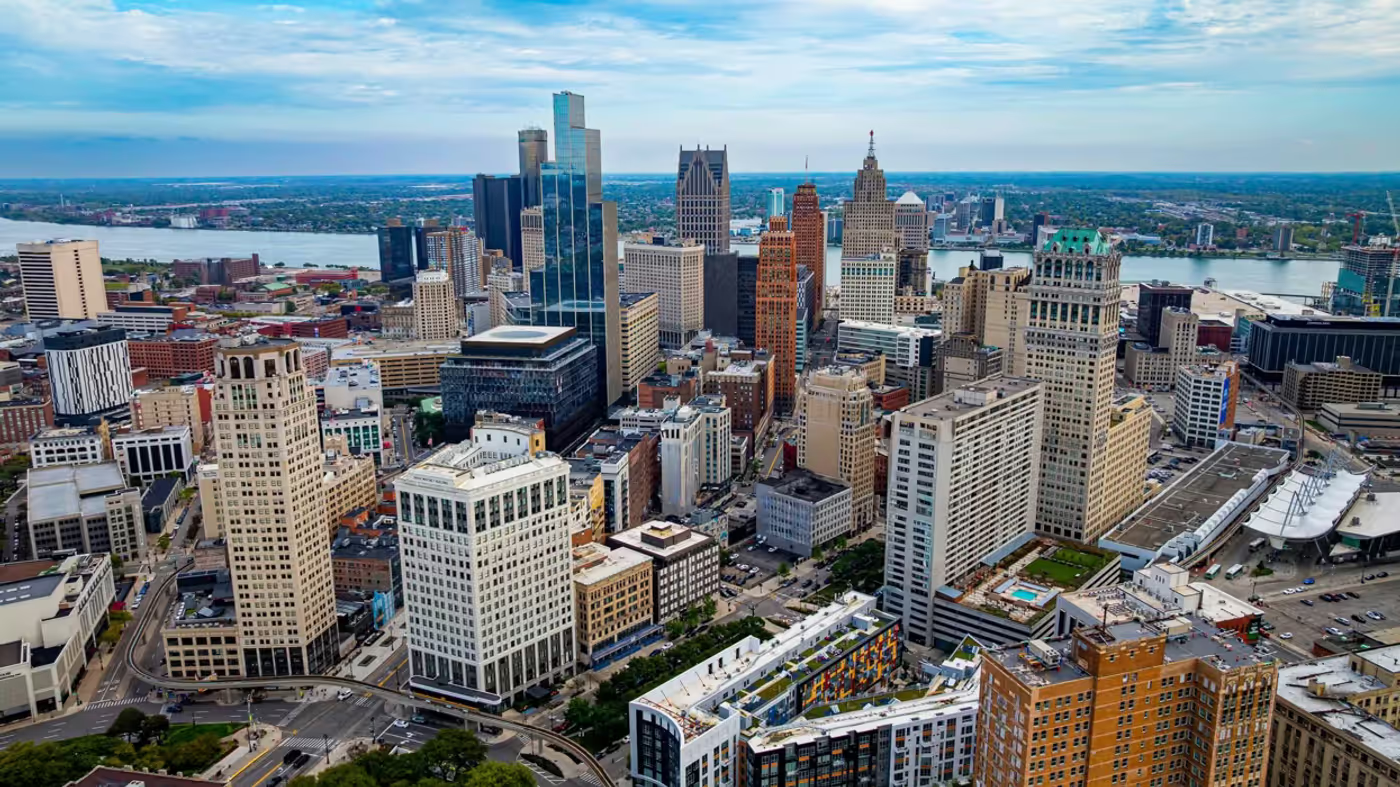
Detroit is a city of about 640,000 people on 139 square miles of wide, fast roads built for twice that population, and the roads are where most of its serious injuries happen. In 2024, according to the Michigan State Police, Wayne County recorded 50,355 crashes, 16,458 people injured, and 177 killed; Detroit accounted for roughly two-thirds of the county’s 637 pedestrian-involved crashes, 420 of them, and for a share of its fatal crashes far out of proportion to its population. Detroit itself recorded 24,321 traffic crashes in 2024, with 8,872 people injured and 104 killed. The city’s injury claims have problems the suburbs’ do not: the state’s highest concentration of uninsured drivers, the most government-owned vehicles and government-maintained property, housing stock that produces falls, fires, and lead exposure, and a court system, the Third Circuit and the 36th District, that is the largest in Michigan.
ATLAW is a personal injury firm with an office at Parklane Towers West in Dearborn, serving clients throughout Detroit and southeast Michigan. This page explains what is particular about a Detroit injury claim: where the injuries happen, who the defendants usually are, which courts hear the cases, and the deadlines that end them. The practice-area pages linked throughout explain the law for each kind of case, and our Wayne County page covers the county as a whole.
Detroit injury numbers, 2024
| Measure | Figure | Source |
|---|---|---|
| Wayne County crashes / injured / killed | 50,355 / 16,458 / 177 | MSP, Michigan Traffic Crash Facts 2024 |
| Pedestrian-involved crashes, Detroit | 420 (two-thirds of Wayne County’s 637) | MSP, Pedestrian Crash Report 2020–2024 |
| Detroit crashes / injured / killed | 24,321 / 8,872 / 104 | MTCF city profile |
| Highest-crash Detroit intersections, 2024 | M-39 (Southfield Freeway) at Warren Avenue, 61 crashes; Livernois at West Davison, 60 crashes, 22 injuries | MSP Traffic Crash Reporting Unit data |
| Detroit drivers uninsured before the 2019 reform | About 60 percent | DIFS |
| Detroit households that rent | About half (50.3 percent own) | U.S. Census, 2020–2024 ACS |
Where Detroit injuries happen
The freeways. I-94 (the Edsel Ford) across the city from Dearborn to the Grosse Pointes; I-75 (the Fisher and Chrysler) from Downriver through Southwest Detroit, downtown, and the North End to Eight Mile; I-96 (the Jeffries) from Redford to the I-75 interchange; M-10 (the Lodge) from downtown to Southfield; M-39 (the Southfield Freeway) along the west side; and M-8 (the Davison), the oldest depressed urban freeway in the country. The interchanges, I-94/I-75, I-75/I-96, I-94/M-10, I-96/M-39, I-75/M-8, carry the merging and lane-change crashes; the stretches with short ramps and left-hand exits carry the rear-end crashes; and the freight to the Ambassador and Gordie Howe bridges puts heavy trucks on all of them. See our Detroit car accident and Detroit truck accident pages.
The arterials. Gratiot, Woodward, Grand River, Michigan Avenue, Fort Street, Jefferson, Van Dyke, Livernois, Warren, Davison, Seven Mile, Eight Mile, and Telegraph: wide, multi-lane, signalized at long intervals, and crossed on foot by residents of neighborhoods with limited transit. These are the pedestrian crashes, 420 in 2024, and the left-turn and red-light crashes at the big intersections. Michigan Auto Law’s analysis of Michigan State Police data puts the Southfield Freeway at Warren (61 crashes) and Livernois at West Davison (60 crashes, 22 injuries) at the top of the city’s 2024 intersection list. See our pedestrian accident page.
The neighborhoods. Detroit’s housing stock is old, and about half the city rents. Falls on deteriorated stairs and porches, injuries from code violations in rental housing (MCL 554.139), fires, carbon monoxide, and childhood lead exposure from pre-1978 paint are a steady source of claims against private landlords, and, where the landlord is the Detroit Housing Commission, claims under the public building exception to governmental immunity (MCL 691.1406) with 120-day notice. Detroit’s sidewalk ordinance permits the City to require adjacent property owners to repair deteriorated sidewalks under Detroit Code § 44-3-141. However, an adjacent owner is not automatically liable to an injured pedestrian merely because of that maintenance responsibility. Liability depends on the applicable law and circumstances, while claims against the City are subject to Michigan’s governmental-immunity rules, including MCL 691.1402a. See our tenant injury, premises liability, sidewalk injury, and Detroit slip and fall pages.
The dogs. Detroit regularly ranks among the U.S. cities with the most dog attacks on postal carriers in the Postal Service’s annual rankings, and attacks on delivery drivers have risen with home delivery. Michigan’s dog bite statute, MCL 287.351, makes the owner strictly liable for a bite on public property or while the victim was lawfully on private property; the limit is usually the owner’s homeowner’s or renter’s policy, which many Detroit dog owners do not carry. See our Detroit dog bite page.
Downtown, Midtown, and the venues. Ford Field, Comerica Park, Little Caesars Arena, the Fox, the three casinos, the Riverwalk, Eastern Market, and the Greektown and Corktown bar districts produce premises claims against the venue operators, dram shop claims against the bars that over-served a driver (MCL 436.1801, 120-day notice), rideshare crashes at the end of the night, and scooter and QLine injuries. See our Detroit rideshare accident page and drunk driving accident page.
The workplaces. The Stellantis Jefferson North and Mack plants, GM Factory Zero, the Marathon refinery, the steel and salt operations in Southwest Detroit, the port, the rail yards, the hospitals, and the construction that has followed downtown’s rebuilding. Workers’ compensation is the exclusive remedy against the employer (MCL 418.131); a worker injured by another company’s negligence has a lawsuit as well. See our Detroit workers’ compensation page.
What is different about a Detroit claim
The other driver is more likely to have no insurance. Michigan’s 2019 reform was driven largely by Detroit, where the state insurance department estimated that about 60 percent of drivers were uninsured. Although Michigan’s overall uninsured-driver rate has fallen since the reforms, uninsured motorists and drivers with limited liability coverage remain important considerations in Detroit injury claims. For your claim: your own no-fault insurer pays your medical bills and lost wages regardless (MCL 500.3107), or the Michigan Assigned Claims Plan does if no household policy applies (MCL 500.3172, capped at $250,000); your pain-and-suffering claim against an uninsured driver is worth what the driver can personally pay unless you carry uninsured motorist coverage; and a Detroit resident who buys UM/UIM coverage has bought the most important insurance in the city. We check every policy in the household before we value a Detroit claim. See our uninsured motorist page and no-fault insurance guide.
The defendant is more likely to be the city. DDOT buses, Detroit Police, Fire, and EMS vehicles, Department of Public Works trucks, city-maintained streets and sidewalks, the Detroit Housing Commission’s buildings, and the Detroit Land Bank Authority’s thousands of properties. Claims involving the City of Detroit and other governmental entities are subject to Michigan’s governmental-immunity rules under MCL 691.1401 et seq. Limited exceptions include MCL 691.1405 for injuries caused by negligent operation of government-owned motor vehicles, MCL 691.1402 for qualifying highway defects, MCL 691.1402a for certain municipal sidewalk defects, and MCL 691.1406 for qualifying dangerous conditions in public buildings. Highway-defect claims generally require written notice within 120 days under MCL 691.1404. The Detroit Land Bank Authority is a separate governmental entity, and its ownership of a property does not automatically create tort liability. Injuries on Belle Isle, which is managed by the Michigan Department of Natural Resources, may involve claims against the State of Michigan. Such claims generally proceed in the Court of Claims only when an applicable exception to governmental immunity or another legal basis permits them. Notice requirements vary by claim; qualifying state highway-defect claims generally require notice within 120 days under MCL 691.1404, while other state claims may be subject to MCL 600.6431. DDOT video, Detroit Police body-camera and dash-camera footage, and Project Green Light camera footage are obtained by Freedom of Information Act request and are overwritten on short schedules.
The police report may take longer. If a Detroit Police officer does not respond to the crash scene, promptly contact the department for instructions on filing the required report. Reporting the crash and documenting the available evidence can help establish what happened. Our checklist covers the first day.
The courts are the largest in the state. Injury suits over $25,000 are filed in the Third Judicial Circuit Court at the Coleman A. Young Municipal Center, 2 Woodward Avenue, which has its own case evaluation and facilitation practices and is part of Michigan’s largest circuit court. Claims up to $25,000, including mini tort claims (MCL 500.3135(3)(e), up to $3,000), go to the 36th District Court at 421 Madison Street, the largest district court in the state. Wrongful death estates (MCL 600.2922) and minors’ settlements (MCR 2.420) go to the Wayne County Probate Court in the same municipal center. Federal claims, ERISA disability suits, and Social Security appeals from the Detroit hearing office go to the U.S. District Court for the Eastern District of Michigan at the Theodore Levin Courthouse on Lafayette.
The hospitals. Detroit Receiving Hospital, Henry Ford Hospital, and Henry Ford St. John Hospital (formerly Ascension St. John) are Level I adult trauma centers, while Children’s Hospital of Michigan is a Level I pediatric trauma center. DMC Sinai-Grace and Harper University Hospital are among the other hospitals serving injured patients in Detroit.
The cases we handle in Detroit
- Car accidents and no-fault benefit claims
- Truck accidents on the freight corridors
- Motorcycle accidents
- Pedestrian and bicycle crashes
- Bus accidents involving DDOT, SMART, and school buses
- Rideshare accidents
- Slip and fall and premises liability, including rental housing injuries
- Dog bites
- Medical malpractice and birth injuries at the city’s hospitals
- Nursing home abuse and neglect at the city’s 28 Medicare-certified nursing homes
- Workers’ compensation
- Wrongful death
- Brain injuries and spinal cord injuries
- Social Security disability for Detroiters who cannot return to work
Deadlines that apply to Detroit claims
| Claim | Deadline | Statute |
|---|---|---|
| Negligence (crash, fall, dog bite) | 3 years from injury | MCL 600.5805(2) |
| Written notice to your no-fault insurer | 1 year from the crash | MCL 500.3145(1) |
| Street or sidewalk defect against the City of Detroit | Written notice within 120 days | MCL 691.1404 |
| Defective public building (Detroit Housing Commission, city buildings) | Written notice within 120 days | MCL 691.1406 |
| Claim against the State (Belle Isle, MDOT trunklines) | Court of Claims notice within 6 months | MCL 600.6431 |
| Dram shop (bar that served a drunk driver) | 120-day notice | MCL 436.1801 |
| Medical malpractice | 2 years, 182-day notice of intent first | MCL 600.5805(8), 600.2912b |
| Injured person under 18 | Clock starts at 18 | MCL 600.5851(1) |
Why Detroiters call ATLAW
- An office at Parklane Towers West in Dearborn, minutes from Southwest Detroit and the west side; 13 years, more than 10,000 cases, more than $100 million recovered.
- Daily work in the Third Circuit, the 36th District, and the Wayne County Probate Court, and with the Assigned Claims Plan, DDOT, the City’s law department, and the insurers that write Detroit policies.
- Every household policy reviewed for UM/UIM before the claim is valued, because in Detroit that coverage is often the recovery.
- We welcome clients to our Dearborn office for a consultation. If you are unable to visit, home or hospital visits can be arranged as needed.
- No fee unless we recover money for you. The first conversation is free. ATLAW advances case costs, so you pay nothing up front; the 33.3% attorney fee is calculated on the recovery after those costs are deducted, and if there is no recovery you owe no fee and no costs.
- Languages. Consultations and intake are available in English, Arabic, French, Mandarin, Urdu, and Spanish.